
Shade is solar’s superpower.
Shade conserves water in the soil and decreases evaporation. Forage grows well under the panels, and it needs to be maintained so it doesn’t block sunlight before it reaches the panels.
The shade also provides heat relief for grazing animals. Studies on heat stress and sheep with access to solar panel shade found a decrease in wool-surface temperature in ewes of 46.4°F and a decrease in skin temperature of 34.7°F1.
What is Solar Grazing?
Solar grazing is the practice of grazing livestock on solar farms. It is a kind of targeted grazing, which has been around for a long time. Think of the sites as solar meadows or solar pastures.
Other terms you might hear to describe solar grazing include agrivoltaics (the co-location of agriculture and solar), agrisolar, agri-pv, or rangevoltaics. Solar grazing constitutes 85% of agrivoltaics in the United States2.
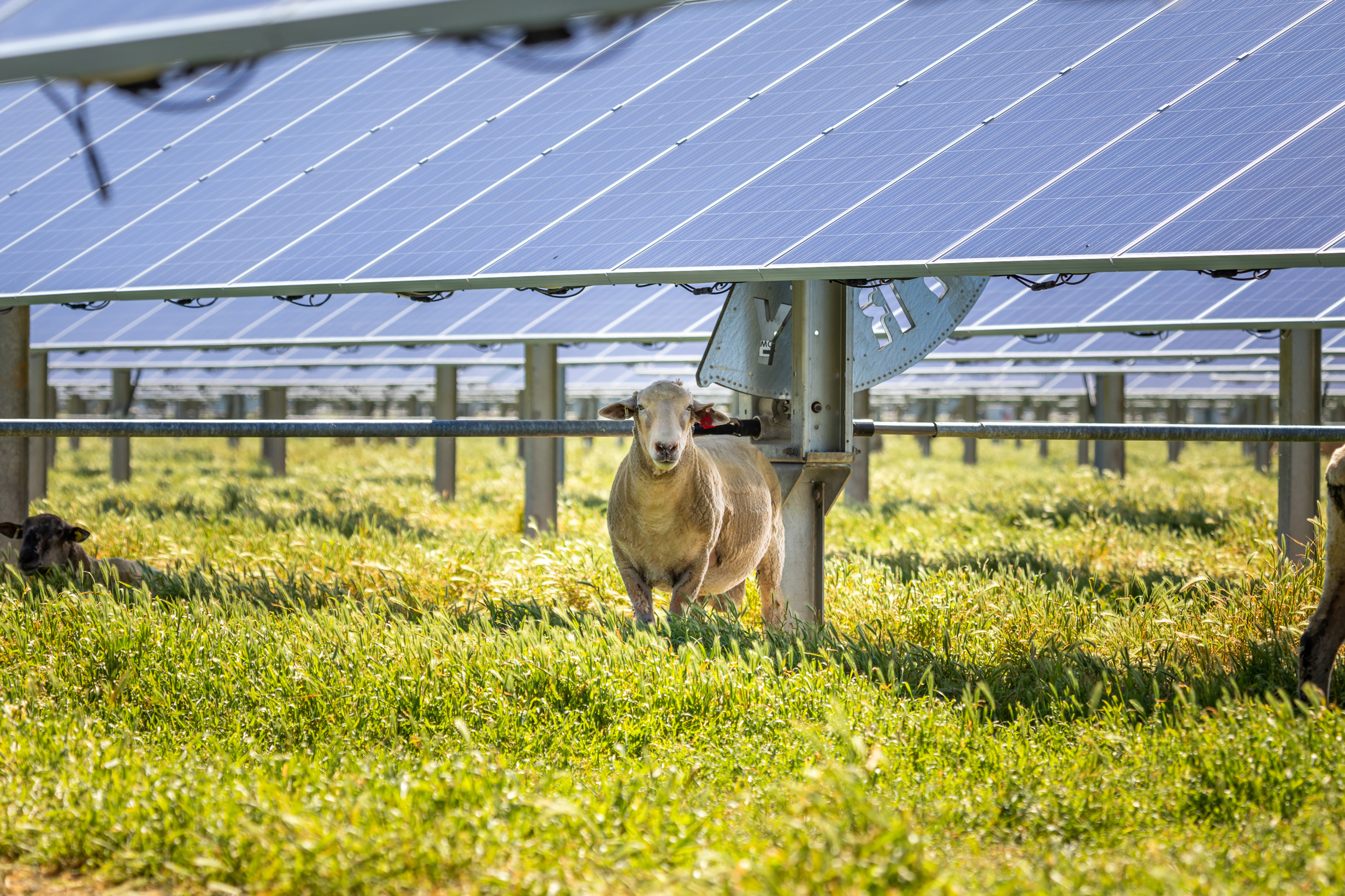
Sheep are the most common solar grazers; they enjoy the shade of the solar panels on hot days and graze where humans would struggle to reach.
Solar graziers are paid by solar companies to provide needed vegetation management and land management services, while reducing or eliminating the need for mechanical mowing and string trimming, which can damage solar panels.
Solar panels do not need to be raised for the sheep. As you can see in the photo, they are nimble and can reach vegetation under the panels, making a perfect partnership.
This isn’t hypothetical research; it is currently happening on
over 130,000 acres at 500 sites in 30 states.
170 solar companies use solar grazing to manage their vegetation.
And this movement is expanding rapidly.
If you want to see solar grazing in action, watch our films from around the country.
Why Solar Grazing?
Solar development is happening now. It will cover 3 million acres of land in the next ten years.
Farm incomes are down nationwide, and, for many, there is a barrier to land ownership. Solar sites provide expanded grazing lands, without the burden of land ownership for the graziers. Because of this, we are seeing first-generation farmers, female farmers, farmers of color, and younger people enter agriculture through solar grazing, in contrast to the aging and declining population of typical American farmers.
Solar grazing presents an opportunity for graziers to continue their work as stewards of the land while diversifying revenue, increasing their operations, and keeping land in agricultural production.
It also presents an opportunity for rural communities. In addition to the stable income local solar graziers bring into the community, the graziers need veterinary care, winter feed, livestock managers, and farming equipment like trucks, trailers, and fencing.
Solar grazing also contributes meat, fiber, and hides to local and regional markets. More than 70% of lamb consumed in the United States is imported, but solar grazing has a tremendous opportunity to strengthen the domestic lamb supply.
A well-managed solar grazing program improves soil health. It brings nutrients to the soil, increases water infiltration, decreases soil erosion, and improves regional biodiversity. It is also a recognized wildfire mitigation strategy.
Footnotes
- Fonesca et al, 2023 https://doi.org/10.1016/j.applanim.2023.105998 ↩︎
- InSPIRE/Agrivoltaics Map | Open Energy Information ↩︎